
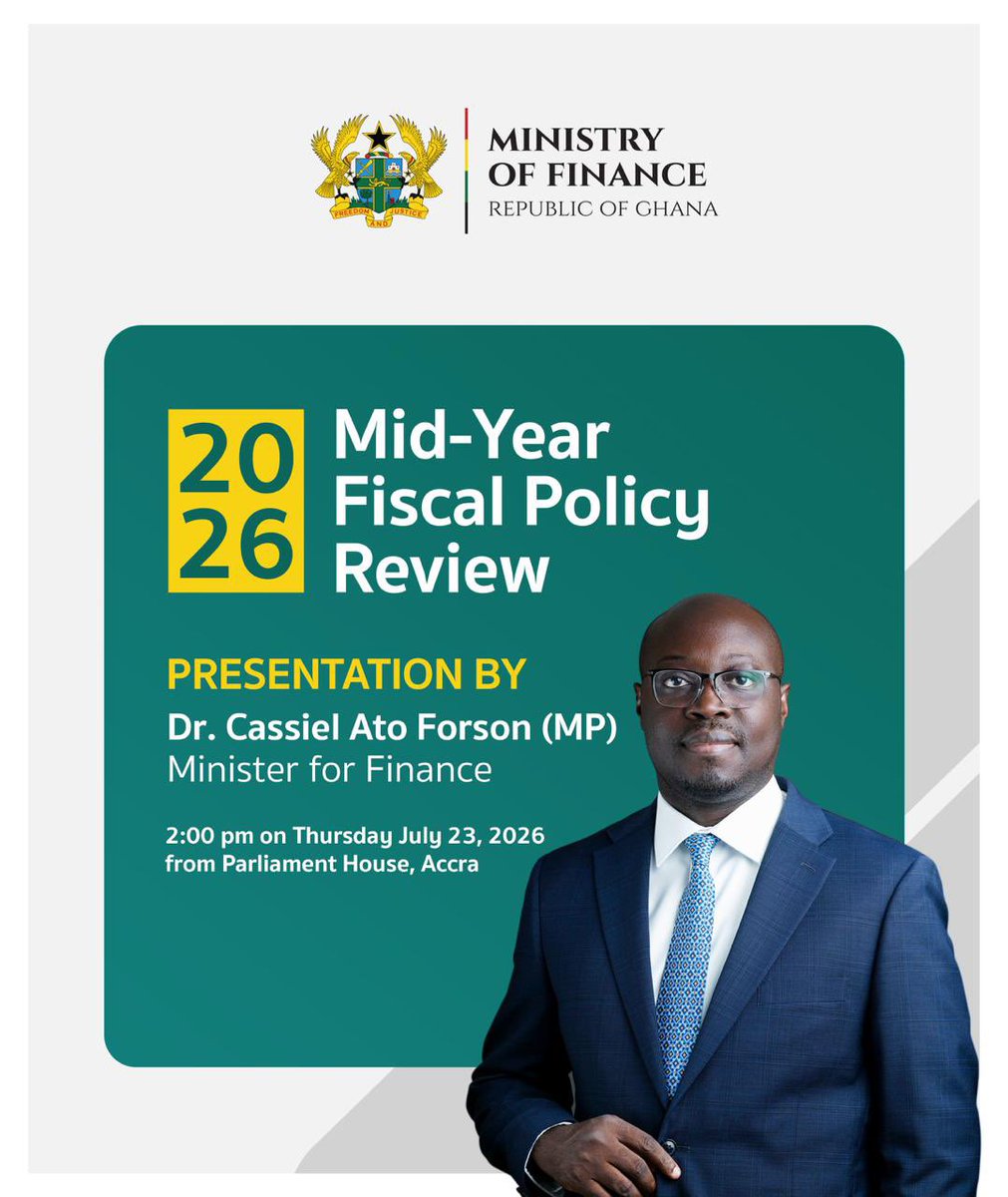
Ghana’s mid‑year budget review for 2026 was delivered to Parliament on 23 July 2026 by the Minister of Finance, Dr Cassiel Ato Forson. In this briefing, the Minister announced that the nation’s economy has, for the first time, exceeded a nominal gross domestic product of US $100 billion. While the overall expenditure ceiling for the year was kept unchanged, the government redirected an internal allocation of GH¢5 billion into the GANRAP/GoldBod structural‑support framework. The update also underscored continued progress on major infrastructure works, most notably the construction of the Accra‑Kumasi expressway.
*Economic Performance and Outlook*
*Economic size: Nominal GDP has now crossed the US $100 billion threshold, and projections anticipate a rise to approximately US $140 billion by the close of 2026.
*Growth rate: The target for total economic growth in 2026 remains around 5 percent, consistent with the Bank of Ghana’s decision to hold the policy (benchmark) lending rate steady at 14 percent.
Fiscal stance: The government chose to retain the previously approved 2026 budgetary expenditure caps rather than expanding the overall fiscal envelope.
*Key Spending Priorities and Sector Highlights*
*Infrastructure “Big Push”: A total of 87 infrastructure projects have been launched under the initiative, with 13 of those projects already achieving at least 50 percent completion as of June 2026.
*Road development: US $1.7 billion has been allocated and deposited into a dedicated central‑bank account earmarked exclusively for the construction of the Accra‑Kumasi expressway.
*Resource reallocation: An internal shift of GH¢5 billion has been made toward growth‑enhancing and structural‑support mechanisms, principally the GANRAP/GoldBod programmes.
*Fiscal and Tax Measures*
*Tax policy: The government’s tax agenda is centred on a technology‑driven compliance drive, the continuation of the value‑added tax (VAT) structural reforms introduced in January 2026, and forthcoming updates to customs and excise duties. No major, sweeping new tax measures were introduced in this review.
2026-Mid-Year-Fiscal-Policy-Review.pdf (1)
About The Author