

The residents of Gomoa Otapirow, located within the Gomoa Assin Traditional Area, recently celebrated their annual Yam Festival, referred to locally as Eguatodo. This vibrant event featured a variety of traditional rites, cultural displays, and a renewed focus on the history and valor of their ancestors.
The festivities were spearheaded by Nana Osompa Nyamekye II, the Chief of Gomoa Otapirow and Nsafoahene of the Gomoa Assin Traditional Area, alongside other traditional leaders and community members.

Traditionally, Eguatodo is observed in the third week of August and serves two significant purposes: the purification of the Black Stool, a revered symbol of traditional authority, and the commemoration of the courage and sacrifice of Osofo Egya Ahor, a figure whose legacy is deeply intertwined with the history of the Gomoa people.
*Purifying the Black Stool*
A pivotal ritual during the festival involves the purification of the Black Stool, which must occur before traditional authorities can partake in the season’s new yam. According to customary practices, freshly prepared eto, or mashed yam, is first sprinkled on the Black Stool. This act is seen as a means of purifying and preparing the stool, symbolically allowing its occupant to partake in the new yam. Only after this sacred rite can the chief enjoy the new harvest.
*Remembering Osofo Egya Ahor*
In addition to celebrating the new yam, Eguatodo offers an occasion for the community to reflect on the historic bravery of Osofo Egya Ahor. Oral traditions recount how he sacrificed his life to save the Borbor Fante people from a devastating epidemic that claimed numerous lives. His heroism and selflessness have become integral to the community’s cultural identity. During the festival, attendees draw inspiration from his legacy of bravery, strength, and altruism.
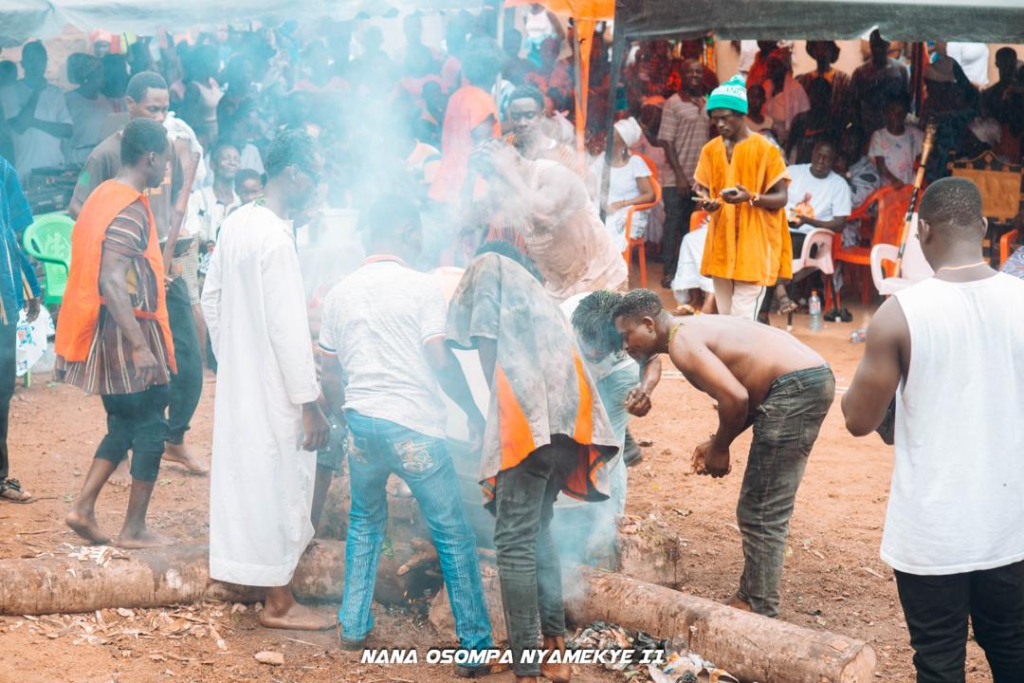
*A Dramatic Display of Courage*
One of the festival’s most striking features is a traditional demonstration of bravery involving yam and meat, particularly sheep meat. Following the ritual sprinkling of mashed yam on the Black Stool, yam and meat are cooked over an open flame. Local men participate in a dramatic display, retrieving the cooked food from the hot cooking vessel using only their bare hands. This act transcends mere consumption; it serves as a symbolic exhibition of courage and strength, reflecting the valor traditionally associated with Osofo Egya Ahor. For the people of Gomoa Otapirow, this ritual reinforces the belief that the spirit of courage and resilience linked to their ancestor continues to thrive within the community.
*Preserving Gomoa Heritage*
Thus, Eguatodo is more than just a celebration of the harvest; it is a festival that forges a connection between the present generation and the historical, cultural, and spiritual heritage of the Gomoa people. Through the purification of the Black Stool, the ceremonial consumption of new yam, and the dramatic exhibition of courage, the residents of Gomoa Otapirow actively preserve traditions passed down through generations. As drums resonate and the community unites in celebration, Eguatodo stands as both a thanksgiving for the new harvest and a poignant reminder of the sacrifices made by those who paved the way for their descendants.
About The Author