
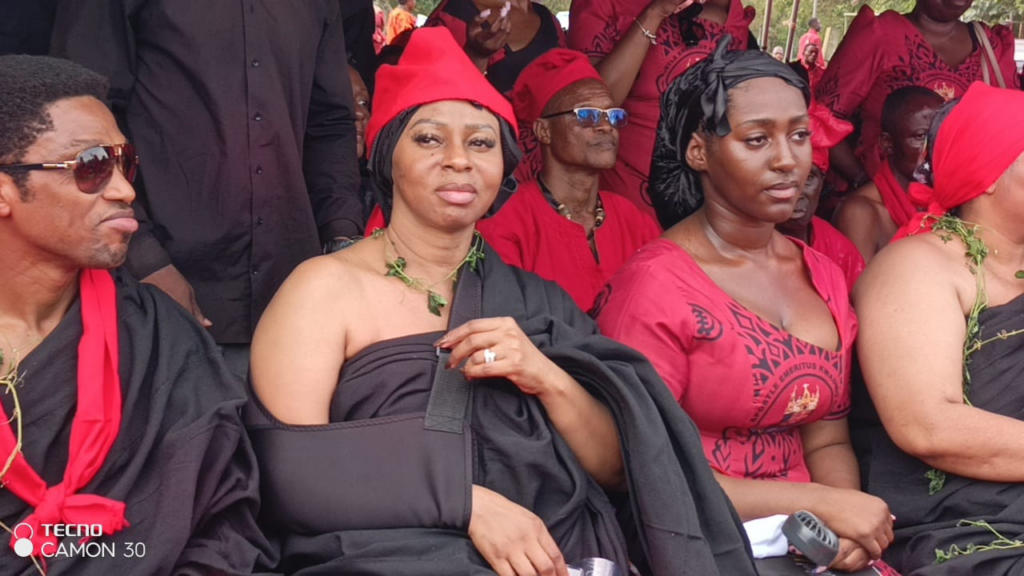
The decision made by former Dome-Kwabenya MP Sarah Adwoa Safo to proceed with the funeral of her late father, Apostle Prof. Emeritus Ing. Kwadwo Safo Kantanka, despite an interim injunction, has sparked a widespread debate regarding the potential legal consequences she may face if the court determines that she deliberately disobeyed its order.
The central issue at hand is no longer merely whether the funeral took place, but rather whether Adwoa Safo’s actions constituted contempt of court. On Wednesday, July 29, 2026, the Accra High Court granted a 10-day interim injunction, effectively restraining Adwoa Safo from proceeding with the funeral arrangements until the court had determined the substantive case before it.
The court was expected to hear the matter within the specified 10-day period before deciding on the next course of action. However, Adwoa Safo went ahead with the funeral rites at Gomoa Mpota on Thursday, July 30, after insisting that the burial would take place regardless of any obstacles.
This development has potentially set the stage for a fresh legal battle. According to Dr. Philip Siaw, the secretary to the Safo family, the family deliberately chose not to disrupt the funeral out of respect for the late Apostle Kwadwo Safo, but would instead seek redress through the courts. Dr. Siaw stated that they would not interrupt the funeral but would return to court, citing that everyone was aware of the injunction in force.
Under Ghanaian law, the alleged breach of a court injunction is considered civil contempt of court. If the party that secured the injunction, in this case, members of the Safo family, believes the order has been violated, they may file contempt proceedings, asking the High Court to determine whether the order was deliberately disobeyed.
Should the court conclude that Adwoa Safo knowingly breached its injunction, it has the authority to impose sanctions under Order 50 of the High Court (Civil Procedure) Rules, 2004 (C.I. 47). One possible consequence is imprisonment, where a judge may commit the contemnor to prison for a fixed term or until the person complies with the court’s order.
The court may also impose substantial financial penalties or fines as punishment for the disobedience. Additionally, the court has the power to order Adwoa Safo’s assets to be temporarily seized until she complies with the directive. Another likely consequence is an order requiring Adwoa Safo to pay punitive legal costs or cover the expenses incurred by the family that initiated the contempt proceedings.
However, legal practitioners caution that contempt is not automatic simply because an injunction exists. Before imposing any sanction, the court must be satisfied that the respondent had knowledge of the injunction and wilfully acted in defiance of it. Adwoa Safo would have the opportunity to respond to the allegations and defend her actions before any punishment, if required, is imposed.
For now, while the first part of the funeral has gone ahead, the legal battle over Apostle Kwadwo Safo Kantanka’s burial appears far from over, with the next chapter likely to unfold in the courtroom.
About The Author