
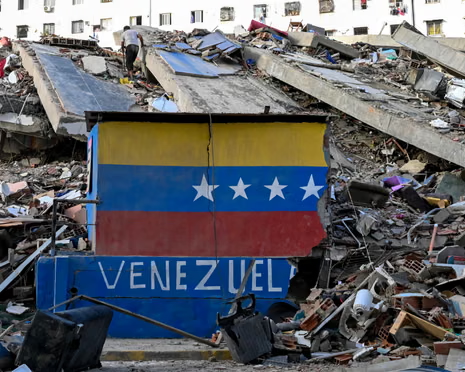
A miraculous rescue operation has been successfully executed in Venezuela, where a three-year-old boy, identified as Klieber Morán, has been pulled alive from the rubble six days after the devastating earthquakes struck the region. According to a statement released by a Jordanian rescue team, the child was rescued from the wreckage in La Guaira state, a region severely affected by the earthquakes. Interim President Delcy Rodríguez has described the child’s rescue as a “source of hope for our people,” bringing a glimmer of light to a nation grappling with the aftermath of the disaster.
The rescue of Klieber Morán comes at a time when the United Nations has issued a warning that tens of thousands of people are in urgent need of food and shelter, highlighting the dire situation on the ground. The death toll from the earthquakes, which had magnitudes of 7.2 and 7.5, has risen to 1,943, with more than 10,000 people injured and tens of thousands more unaccounted for. The massive tremors are believed to have damaged or destroyed 58,870 buildings, according to an initial assessment of satellite data provided by NASA.
The Jordanian civil defence team has reported that Klieber Morán has been given first aid treatment and has been taken to a hospital, where his vital signs are being closely monitored. Fortunately, his condition is stable, and he is receiving the necessary medical attention in the capital city of Caracas, as confirmed by Venezuelan Assembly President Jorge Rodríguez. This rescue is particularly remarkable, as it has occurred well after the initial three-day period immediately following the quake, during which experts believe that people trapped under debris have the best chance of being found alive.
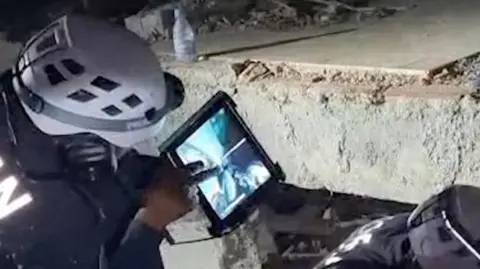
La Guaira is one of the hardest-hit areas, with many local residents taking it upon themselves to carry out rescue efforts. The United Nations refugee agency has reported that food shortages are widespread, basic services have broken down, and communications have been largely severed in the region. The agency has warned that “community tensions are rising as access to assistance remains constrained,” highlighting the urgent need for humanitarian aid. The situation on the ground is dire, with reports of people fighting for food and other essential supplies. As an 18-year-old vendor in La Guaira, Daniela Armas, who was injured during the quakes, described the situation: “some supplies are being distributed, but sometimes people nearly kill each other for food… it’s like a cockfight.”
The United Nations High Commissioner for Refugees (UNHCR) has appealed for an initial $15 million to “scale up protection, core relief items, and temporary shelter support for 30,000 earthquake-affected people over six months.” Meanwhile, the World Health Organization (WHO) has warned that health services are under “extreme pressure,” with an increased risk of outbreaks of vaccine-preventable diseases such as measles and diphtheria due to low vaccination coverage. According to WHO spokesman Christian Lindmeier, the situation is critical, and urgent action is needed to prevent further health crises.
As the search for survivors continues, international rescue teams from the US, Mexico, and dozens of other countries are working tirelessly with trained dogs and heavy equipment to locate those trapped under the rubble. Domestic and international teams are still searching through the debris, and shelters have been set up in La Guaira and other states to provide assistance to those affected. The rescue of Klieber Morán has brought hope to the nation, and Jorge Rodríguez has emphasized that there is still a possibility of finding more people alive.
In a bid to alleviate the suffering of the affected population, international aid is beginning to arrive in the country. A UN spokesperson has confirmed that a 47-tonne shipment of humanitarian supplies, including emergency health kits, supplies for safe births, newborn care, and disease prevention, arrived on Tuesday. As the people of Venezuela struggle to come to terms with the devastating loss of life and property, they have begun burying the dead who have been found so far. Many more are waiting anxiously to identify the remains of their loved ones who are presumed dead. At the makeshift morgue in La Guaira’s port, Wilker Molalla is waiting to identify the remains of his sister, her children, and the children of his brother, a poignant reminder of the human cost of the disaster. As he recounted the tragedy that befell his family, he said: “There were 11 people in my household. Only two of us survived because we were at work.”
About The Author