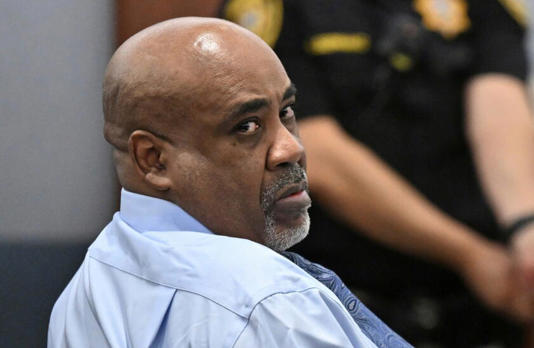
On Monday, a jury in Las Vegas rendered a verdict of guilty against Duane “Keffe D” Davis, a former leader of a Compton gang, in connection with the murder of rapper Tupac Shakur. This decision represents a significant development in a murder investigation that has intrigued the public for nearly three decades.
The jurors deliberated for only a few hours during the trial, which centered on Davis, who is accused of orchestrating the fatal shooting of Shakur near the Las Vegas Strip almost 30 years ago. Prosecutors contend that Davis, now 63, facilitated the rapper’s assassination by acquiring a .40-caliber handgun and distributing it to members of the Southside Crips-Burris Street gang while they traveled in a Cadillac on September 7, 1996.
The prosecution asserted that the motive behind this act was revenge, following an incident earlier that day when Shakur, along with Death Row Records founder Marion “Suge” Knight and members of the Mob Piru gang, allegedly assaulted Davis’ nephew, Orlando Anderson, at the MGM Grand.
“Duane Davis, within the gang culture, could not allow this affront to go unanswered,” Clark County Chief Deputy District Attorney Binu Palal stated during his closing arguments. “He secured a firearm, gathered his associates, and sought out Mr. Shakur or Mr. Knight.”
In their concluding remarks, prosecutors emphasized that jurors had been presented with not only Davis’ own incriminating statements from interviews but also a wealth of circumstantial evidence linking him to one of the most notorious murders in contemporary history.
Conversely, Anthony Sanft, Davis’ defense attorney, argued that the prosecution lacked forensic evidence, eyewitness accounts, and any physical proof placing Davis inside the Cadillac with the gunman. “The state wishes for you to accept this as a confession, suggesting he was present at the shooting,” Sanft told the jury. “We can’t even confirm that Davis was in Las Vegas at that time.”
Sanft maintained that his client fabricated details during a 2008 interview with Los Angeles police and federal agents, conducted as part of the investigation into the 1997 murder of Christopher Wallace, known as Biggie Smalls, in an attempt to evade a life sentence for drug offenses. He further alleged that Davis reiterated elements of these fictitious accounts to promote his 2019 memoir, “Compton Street Legend,” claiming, “You’re reading a narrative that is purely fictional.”
The defense attorney also pointed out that during a documentary interview near the crime scene, Davis misidentified the location of the shooting.
However, Palal countered that Davis acted out of a sense of duty to retaliate for his nephew’s assault. He described how the shooting transpired when the Cadillac, carrying Davis and his associates, encountered Shakur and Knight’s BMW. “In that moment, instead of driving past, they made a U-turn, passed the firearm, and opened fire into Tupac and Suge Knight’s vehicle,” Palal explained.
Both Shakur and Knight were injured in the incident; while Knight survived, Shakur succumbed to his injuries a few days later in a Las Vegas hospital.
Palal further clarified to the jury that, under Nevada law, participation in a conspiracy implicates one in murder, asserting that “you don’t have to pull the trigger” to be held accountable. He emphasized that the decision to make a U-turn illustrated premeditation.
During the trial, the prosecutor played a recording from a 2008 interview with a LAPD federal task force, in which Davis identified Terrence Brown as the driver of the Cadillac that night, with Anderson and Deandrae “Big Dre” Smith in the backseat, and himself in the passenger seat. He stated they only recognized their targets in the BMW because women in a Chrysler Sebring were vocally directing attention to the rapper. “Tupac gave himself away; otherwise, they would have escaped,” Davis was heard saying.
“If it had been on my side, I was going to blast,” Davis recounted in the recording, explaining that he passed the firearm to Smith, who was reluctant to shoot, prompting Anderson to take the weapon and fire. “I saw a bullet go into Suge’s head. I thought he was dead,” Davis recalled, describing how Shakur dove toward the back seat of the BMW.
Palal noted that the presence of women in the Sebring had never been disclosed publicly. “This case is saturated with circumstantial evidence,” he asserted.
He also referenced testimony from retired Compton Police Detective Robert Ladd, who confirmed the gang affiliations of Davis and his associates, stating that Davis was a prominent figure within the Compton Southside Crips. Both Ladd and an FBI agent corroborated that Davis had connections with the Harlem drug dealer alleged to have supplied the weapon used in the shooting.
Palal recounted that a wounded Shakur, while in an ambulance, told a police officer, “We’ll take care of it.” He reminded jurors that Ladd had testified that the Mob Piru gang exclusively targeted the Southside Crips following Shakur’s shooting, despite the presence of over 50 gangs in Compton at that time.
In contrast, Sanft argued there was no concrete evidence of the purported triggering incident that sparked the gang conflict namely, Anderson allegedly taking a Death Row chain from a Mob Piru at the Lakewood Mall. He contended that the prosecution could not definitively establish who was in the Cadillac and highlighted that a female witness present during the event testified she never heard anyone calling out Tupac’s name, as Davis had claimed to police and in his book.
Sanft portrayed both Compton and Los Angeles police as corrupt, particularly targeting former LAPD Detective Greg Kading, who conducted the 2008 interview with Davis and subsequently authored a book about the murders of Tupac and Biggie.
He questioned why jurors had not heard from Kading or Knight, who received a 28-year prison sentence after pleading no contest to voluntary manslaughter in 2018. Furthermore, he pointed out that investigators had failed to pursue leads regarding a white Cadillac that witnesses described as part of the Death Row entourage that night. He raised concerns about why former Compton police officer Reggie Wright Jr., who was responsible for security at the record label, left Shakur who had previously been targeted in multiple shootings largely unprotected that evening. “Only one unarmed bodyguard for the most popular rap artist in the world,” Sanft remarked.
Source: Los Angeles Time
About The Author