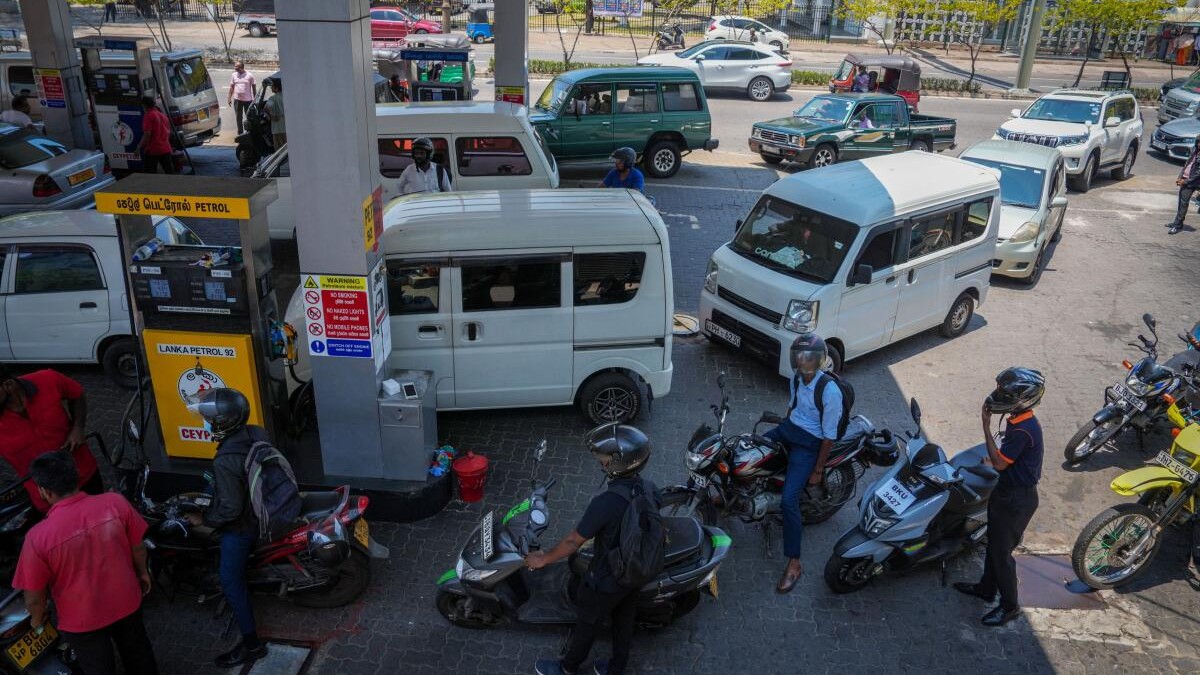
At a petrol station located in the south-eastern region of Moscow, Svyatoslav has found himself waiting in his vehicle for an extensive two hours. The electronic sign ahead has just been updated to indicate that there is no fuel available.
“People are saying there will be petrol here,” Svyatoslav conveys with a sense of optimism. “They just can’t specify when it will arrive—perhaps today, perhaps tomorrow.”

When asked why he doesn’t leave to seek another station, he replies, “I don’t have enough fuel in my tank to make that journey.”
Even if he did, a quick resolution to his fuel woes seems unlikely. This week, long lines for petrol have formed not only in Moscow but across various regions of Russia.
“Unscheduled repairs at oil refineries,” Russian officials explain, attributing the delays to recent Ukrainian drone strikes targeting oil facilities. These long-range attacks have already triggered significant fuel shortages earlier this summer, and the assaults on oil refineries have persisted unabated.
Currently, the queues in Moscow appear to be longer than ever. Authorities seem to be grappling with ongoing issues related to refining capacity and logistics.
“A second wave of the fuel crisis is emerging,” proclaimed the broadsheet Nezavisimaya Gazeta this week.
As one navigates through Moscow, two striking observations arise: large patriotic advertisements on massive billboards celebrating Russian Flag Day, juxtaposed against the sprawling lines of vehicles waiting for petrol.
Outside one petrol station, I observe a staggering 80 cars lined up, all in search of fuel.
The quest for petrol has transformed into a relentless ordeal.
“Last night, I attempted to get petrol at 11 PM,” recounts Elizaveta, who finds herself in yet another queue. “By midnight, I reached the front, only for them to close the station until 2 AM.”
“I drove into Moscow from the provinces yesterday,” Lyubov shares. “It was nothing but empty petrol stations along the way.”
To maintain her composure in the line, Lyubov gently strokes her pet dog, Agatha.
How does Lyubov perceive the ongoing fuel crisis?
“Everyone acknowledges that the situation in the country is challenging,” she remarks. “People connect this to the broader circumstances we’re facing.”
Prior to Russia’s full-scale invasion of Ukraine in 2022, there were no drone strikes on Russian oil refineries or facilities within the country. Despite the ongoing attacks, the Kremlin remains steadfast in its stance, continuing what it refers to as a “special military operation” against Ukraine.
In a bid to alleviate the crisis, Russia has begun importing petrol—an extraordinary move for a nation widely recognized as an energy superpower and a leading exporter of crude oil.
To combat the fuel shortages, the government has also temporarily authorized the production and sale of lower-grade petrol, such as Euro 2, which can be produced more rapidly. Notably, Euro 2 contains up to 50 times more sulfur than the modern Euro 5 and was banned in Russia back in 2013.
The government publication Rossiyskaya Gazeta issued a warning: “For modern vehicles, regular use of lower-grade petrol can heighten pressure on fuel injectors, spark plugs, oxygen sensors, catalytic converters, and soot filters. While a single refueling with Euro 2 won’t damage an engine, it significantly decreases its safety margin.”
The implications of the war extend beyond just the targeting of oil facilities. Ukrainian strikes on distribution centers of Wildberries, Russia’s equivalent of Amazon, have caused disruptions for shoppers and economic strain for sellers.
This week, President Vladimir Putin acknowledged that attacks on industrial facilities and infrastructure “do inflict damage; this is evident. We understand this, we see it.”
However, the Kremlin leader downplayed the severity of the issues, stating, “There are no critical consequences from such attacks. There have not been and cannot be.”
In effect, he suggested that there is no need for alarm.
“It reflects a disconnect between the public’s sentiments and the reality described by Vladimir Putin—his personal reality,” argues Andrei Kolesnikov, a columnist for the independent news outlet Novaya Gazeta. “Perhaps he’s trying to convince himself that everything is fine.”
Recent polling within Russia, including surveys conducted by the Public Opinion Foundation, indicates a rise in societal anxiety. This suggests that the Kremlin’s message of ‘keep calm and carry on’ is failing to resonate.
“This persistent feeling of anxiety is prevalent among everyone right now. There’s a sense that something is amiss. Anxiety is the dominant sentiment,” Kolesnikov observes.
“This regime fails to present any vision for the future—be it immediate, mid-term, or long-term. We are ‘great’ at present. But what defines this greatness? The petrol crisis? In that sense, the future appears bleak. People are attempting to avoid contemplating what lies ahead. Their planning horizon has become exceedingly short.”
Just a few minutes’ drive from the petrol station where I conversed with Svyatoslav, I come across another lengthy queue.
This one, however, is for candyfloss.
Local authorities have set up stalls and organized a street concert in celebration of Russian Flag Day.
While petrol may be scarce, patriotism appears abundant.
“It’s my country, my fate, my dream,” sings a performer, raising a flag. “I’m hoisting my country’s banner.”
Volunteers are distributing Russian tricolors to attendees in the square.
“Dear friends, we live in a wonderful country!” proclaims one of the speakers. “We know we will always emerge victorious. I wish you peaceful skies, uplifting spirits, comfort, prosperity, and pride in our nation.”
Alongside the candyfloss, Kalashnikovs are on display. At one stall, children are being shown a range of military hardware, including handheld rocket launchers. The youngsters eagerly pick up the weapons, posing for photographs.
This scene hints at the increasing militarization of Russian society.
The patriotic festivities seem to uplift some spirits.
“Adversity brings us together,” reflects pensioner Tatyana. “The tougher things get, the stronger we become.”
Yet the war remains a prominent concern for many, particularly the Ukrainian drone strikes affecting the Moscow region.
“When you go to sleep, you don’t know if you’ll wake up in the morning,” Angelina shares. “That’s the real issue. Everything else is manageable.”
“The problems we face include high prices, petrol shortages, and last night, for the first time, my windows shook. I heard ‘boom boom!’” another woman adds.
“Right now, it’s crucial to maintain a strong and resilient psychological state, so that no matter what happens, you can say: ‘Oh well, never mind.’”
Such comments suggest that many Russians feel powerless to influence the unfolding events around them. Instead, they perceive their only option as adapting to the circumstances.
Source: BBC
About The Author