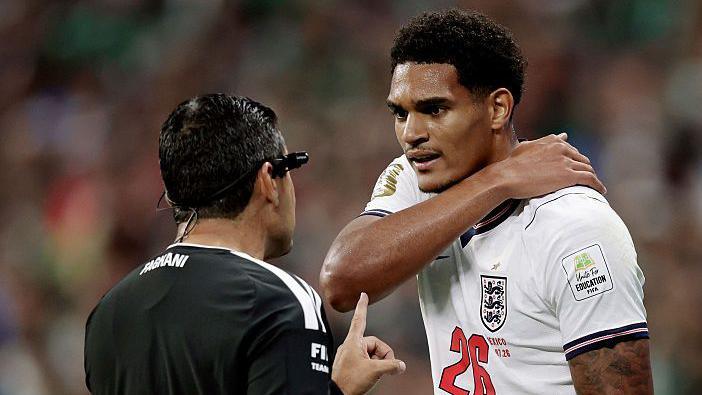
England’s defender, Jarell Quansah, has been handed a two-match suspension due to the red card he received during the match against Mexico, a decision that has significant implications for the team’s upcoming quarter-final match against Norway.
Quansah was given his marching orders in the 54th minute of the intense 3-2 victory over Mexico, following a high challenge on Jesus Gallardo that was deemed serious foul play by the referee, resulting in an automatic one-game suspension, which was subsequently increased to two matches by Fifa’s disciplinary committee due to the severity of the offense.
As a consequence of this ruling, the 23-year-old Bayer Leverkusen player, who previously played for Liverpool, will be forced to miss the crucial quarter-final match against Norway, scheduled to take place on Saturday, as well as a potential semi-final encounter against either Argentina or Switzerland, although he will be eligible to participate if England advances to the final, which is set to take place in New Jersey on July 19.
The Football Association had been considering lodging an appeal against the suspension; however, according to the tournament regulations, there is no provision for contesting the ban, leaving the team with no choice but to accept the decision and plan accordingly.
BBC Sport has been informed that the FA made strong representations to Fifa regarding the process that led to the Quansah red card decision, arguing that the referee was shown a still image of the tackle and slow-motion replays before being shown the incident in real-time on the pitchside screen, which could have potentially resulted in ‘outcome bias’, a concern that highlights the complexities and challenges of implementing VAR technology in high-stakes matches.
In the Premier League, the protocol for reviewing incidents is different, with officials being shown the footage at full speed first, a approach that is not universally adopted, with the World Cup using a different sequence, where officials are shown a still image of the point of contact, followed by slow-motion replay, and finally the full-speed footage, a variation that underscores the need for consistency and clarity in the application of VAR protocols.
The suspension of Quansah complicates matters for head coach Thomas Tuchel, particularly in the right-back position, where Quansah had been filling in for the injured Reece James, with Djed Spence only being used as a substitute due to a minor fitness issue, a situation that highlights the challenges of managing a team’s resources and adapting to unexpected setbacks.
Tuchel has expressed optimism that James will be available for the match against Norway, having missed previous games due to a hamstring injury sustained in the second group match against Ghana, a development that could provide a significant boost to the team’s chances of advancing to the next round.
Tuchel’s assistant coach, Anthony Barry, described the Quansah news as “disappointing”, not with the decision itself, but with the fact that the team will be losing a talented player, who had been performing exceptionally well in training, and whose absence will be felt, particularly given the injuries in that position, a sentiment that reflects the challenges of managing a team’s resources and adapting to unexpected setbacks.
Winger Bukayo Saka also expressed his frustration with the ban, describing it as “incredibly frustrating for us, and for him”, but emphasized the need for the team to adapt and move forward, rather than dwelling on the decision, a mindset that will be crucial in the team’s quest to overcome the obstacles and achieve success in the tournament.
In a related development, Fifa has announced that French referee Clement Turpin, who officiated England’s 4-2 win over Croatia, will be in charge of the Norway match, a decision that will be closely watched, given the high stakes and intense scrutiny of the tournament.
The Quansah suspension has also highlighted the inconsistencies in the application of disciplinary measures, with some arguing that United States forward Folarin Balogun should have received a similar punishment for his red card against Bosnia-Herzegovina, a decision that has sparked widespread criticism and debate, with many questioning the fairness and consistency of the disciplinary process.
The Balogun case has been particularly contentious, with US President Donald Trump confirming that he had called Fifa president Gianni Infantino to request a review of the red card, a development that has added to the controversy and raised questions about the role of external influences in the decision-making process.
Fifa’s decision to suspend Balogun for only one match, and to suspend it for 12 months, has been widely criticized, with many arguing that it was too lenient, and that it undermines the integrity of the disciplinary process, a concern that highlights the need for transparency, consistency, and fairness in the application of disciplinary measures.
The controversy surrounding the Balogun case has also sparked a debate about the use of VAR technology, with some arguing that it was misapplied in the case, and that it has the potential to influence the outcome of matches, a concern that underscores the need for careful consideration and evaluation of the role of technology in the decision-making process.
However, a closer examination of the VAR protocol reveals that it is designed to provide a balanced and nuanced approach to reviewing incidents, with a combination of full-speed and slow-motion footage being used to assess the intensity of the challenge and the point of contact, a approach that is intended to provide a more comprehensive and accurate understanding of the incident, and to ensure that decisions are made on the basis of a thorough and impartial evaluation of the evidence.
Ultimately, the Quansah suspension and the Balogun case highlight the complexities and challenges of managing a team’s resources, adapting to unexpected setbacks, and ensuring fairness and consistency in the application of disciplinary measures, a set of challenges that will require careful consideration, nuanced evaluation, and a commitment to transparency and accountability if the team is to achieve success in the tournament.
About The Author